

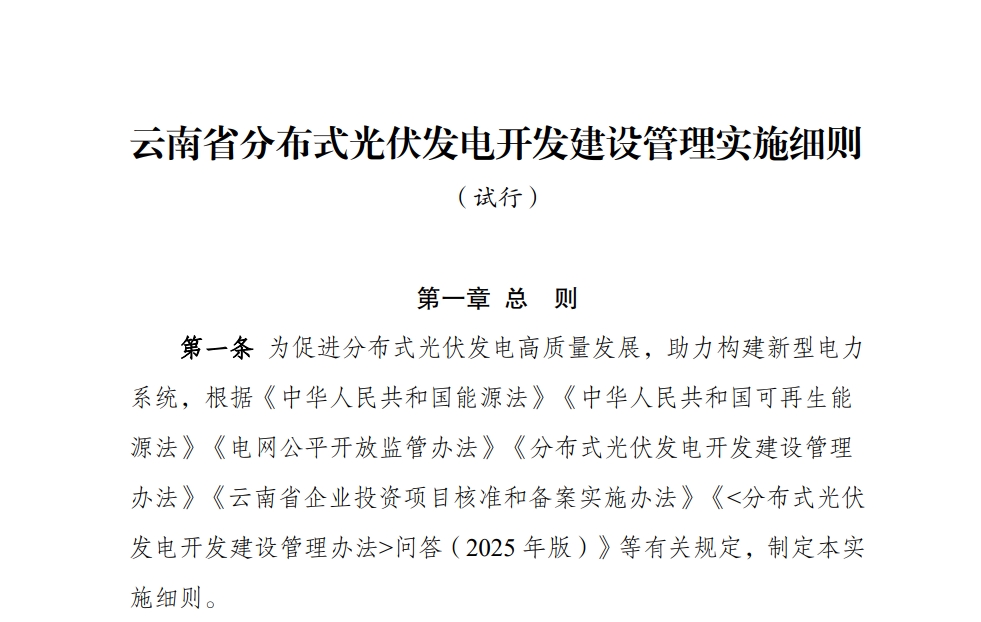
On September 29, the Yunnan Provincial Energy Bureau and the Yunnan Energy Regulatory Office jointly issued the "Implementation Rules for the Development and Construction Management of Distributed PV Power Generation in Yunnan Province (Trial)," which took effect immediately upon issuance and will remain valid for five years. This represents a concrete implementation measure by Yunnan following the national-level "Management Measures for the Development and Construction of Distributed PV Power Generation (2025 Edition)," tailored to local conditions, aiming to promote the healthy and orderly development of distributed PV and support the construction of a new-type power system.
The document first clarifies four categories of distributed PV projects: residential for natural persons, residential for non-natural persons, general industrial and commercial, and large-scale industrial and commercial, setting capacity and grid connection voltage limits for each. For residential projects, users can still flexibly choose among full grid feed-in, complete self-consumption, or "self-consumption with surplus electricity fed into the grid" models. However, requirements for industrial and commercial projects are significantly stricter. For general industrial and commercial PV projects, those relying on public institutions must have a self-consumption ratio of no less than 30%, while those based on industrial and commercial premises must achieve at least 50%. Large-scale industrial and commercial distributed PV projects are, in principle, required to be entirely self-consumed, with anti-backflow devices installed to prevent reverse power flow to the grid. Only during the continuous operation of the South China regional power spot market are they permitted to adopt the "self-consumption with surplus electricity fed into the grid" model to participate in spot market transactions.
Regarding filing management, the rules emphasize "who invests, who files," requiring all projects to be filed by the actual investment entity, strictly prohibiting the filing of non-natural person investment projects under a natural person's name. Filing information must include key elements such as the investment entity, construction scale, location, and grid connection model. For projects connected at 35 kV or 110 kV voltage levels, if significant changes occur in the construction scale, they will be uniformly managed as large-scale industrial and commercial projects, with the grid connection model adjusted to "full self-consumption." Additionally, if the load of large-scale industrial and commercial users changes significantly, the investment entity may apply to convert the project into a centralized PV power station, but must undergo renewed permitting, filing, and grid connection procedures.
The document also imposes higher requirements for construction and grid connection. Projects must be legally compliant, have clear property rights, and meet standards for structural safety, fire protection, and lightning protection, while encouraging the adoption of building-integrated photovoltaics (BIPV). Grid companies are required to optimize grid connection service processes, disclose available capacity and technical standards, provide "one-stop" services, and must not impose restrictions or charge fees in any form. New projects must possess capabilities for "visibility, measurability, adjustability, and controllability." General industrial and commercial projects must also demonstrate compliance with self-consumption ratios during the design phase; otherwise, they must reduce the construction scale or configure flexible regulation resources such as ESS.
In terms of operational management, the investment entity is the safety production responsible party, must strictly adhere to operation, maintenance, and data security regulations, and complete project registration within one month after commissioning. All distributed PV power generation can be issued green electricity certificates, with the grid-fed portion forming tradable green certificates. Energy authorities at all levels and grid companies will quarterly publish grid connection and consumption data, and conduct annual evaluations and spot checks on the self-consumption ratios of industrial and commercial PV. The document also states that projects filed before January 23, 2025, and commissioned before May 1 will still be governed by previous policies.
SMM believes that the mandatory self-consumption ratios set for industrial and commercial distributed PV and the positioning of large-scale industrial and commercial PV as "principally fully self-consumed" reflect Yunnan's approach to balancing new energy consumption with grid security. As the proportion of clean energy installed capacity in Yunnan continues to rise, this policy is expected to promote distributed PV development closer to user loads, alleviate local grid pressure, and, through the spot market mechanism, release more flexibility for large users.
[SMM Analysis] Yunnan Issues Detailed Rules for Distributed PV Management: Strengthening Self-Consumption Ratio to Promote High-Quality Development
[SMM Analysis] On September 29, the Yunnan Provincial Energy Bureau and the Yunnan Energy Regulatory Office jointly issued the "Implementation Rules for the Development and Construction Management of Distributed PV Power Generation in Yunnan Province (Trial)," which took effect immediately upon issuance and will remain valid for five years. This represents a concrete implementation measure by Yunnan following the national-level "Management Measures for the Development and Construction of Distributed PV Power Generation (2025 Edition)," tailored to local conditions, aiming to promote the healthy and orderly development of distributed PV and support the construction of a new-type power system.
photovoltaic price trendsNew EnergyPhotovoltaic PriceSolar EnergySolar Energy PricePhotovoltaic IndustryClean Energy
Data Source Statement: Except for publicly available information, all other data are processed by SMM based on publicly available information, market communication, and relying on SMM‘s internal database model. They are for reference only and do not constitute decision-making recommendations.
For any inquiries or to learn more information, please contact: lemonzhao@smm.cn
For more information on how to access our research reports, please contact:service.en@smm.cn
Related News
![[SMM PV News] CHN Energy Commissions 4 GW Lingwu PV Base on Subsidence Land](https://imgqn.smm.cn/usercenter/dtQDq20251217171740.jpg)
2 hours ago
[SMM PV News] CHN Energy Commissions 4 GW Lingwu PV Base on Subsidence Land
Read More
[SMM PV News] CHN Energy Commissions 4 GW Lingwu PV Base on Subsidence Land
CHN Energy has fully commissioned its 4 GW Lingwu PV project in Ningxia, following the grid connection of its Phase II 2 GW section. Part of a massive 6 GW mining-subsidence base, the site will deliver 10.8 TWh annually to the east via the 800 kV Ningxia-Zhejiang UHVDC line.
The project pioneers a 'solar-coal-storage-hydrogen' model, bundling PV with existing thermal assets and a 400 MW/800 MWh grid-forming storage system to smooth variability. By repurposing degraded coal lands, integrating 'PV + ecology' for vegetation recovery, and sharing an existing 750 kV coal plant substation, the base sets a benchmark for land reuse and long-distance clean energy transmission in western China.
2 hours ago
![[SMM PV News] France's 2025 Renewable Curtailment Doubles to 3 TWh](https://imgqn.smm.cn/usercenter/LlMgj20251217171739.jpg)
2 hours ago
[SMM PV News] France's 2025 Renewable Curtailment Doubles to 3 TWh
Read More
[SMM PV News] France's 2025 Renewable Curtailment Doubles to 3 TWh
France's grid operator RTE reported a near doubling of renewable energy curtailment in 2025 to almost 3 TWh. Driven by expanding capacity and frequent negative wholesale prices, solar and wind generators on 'premium' schemes increasingly reduced output to prevent grid imbalances. While total 2025 generation reached 547.5 TWh (over 95% low-carbon), the surge in curtailment underscores the urgent need for enhanced flexibility solutions like battery energy storage and demand response.
2 hours ago
![[SMM PV News] Premier Energies Unveils India's First 0BB TOPCon Solar Cell](https://imgqn.smm.cn/usercenter/vghcI20251217171739.jpg)
21 hours ago
[SMM PV News] Premier Energies Unveils India's First 0BB TOPCon Solar Cell
Read More
[SMM PV News] Premier Energies Unveils India's First 0BB TOPCon Solar Cell
Premier Energies launched India's first zero-busbar (0BB) TOPCon solar cell at Intersolar Gandhinagar. Replacing traditional thick silver busbars with ultra-fine silver lines, the new architecture significantly reduces silver consumption and shading losses while boosting power output, mechanical flexibility, and resistance to micro-cracks. The innovation aligns with the manufacturer's $1.36 billion, three-year expansion plan to double its capacity, integrate backwards into ingot-wafers, and enter the inverter and battery markets.
21 hours ago
Related News
[SMM PV News] CHN Energy Commissions 4 GW Lingwu PV Base on Subsidence Land
Mar 03, 2026 11:29
[SMM PV News] France's 2025 Renewable Curtailment Doubles to 3 TWh
Mar 03, 2026 11:27
[SMM PV News] Premier Energies Unveils India's First 0BB TOPCon Solar Cell
Mar 02, 2026 15:38
Upstream Silicon Market Prices Mostly Held Steady Over the Weekend Downstream Module Quotes Showed an Uptrend [SMM Silicon-based PV Morning Meeting Summary]
Mar 02, 2026 10:22